
The meaning of snowdrops
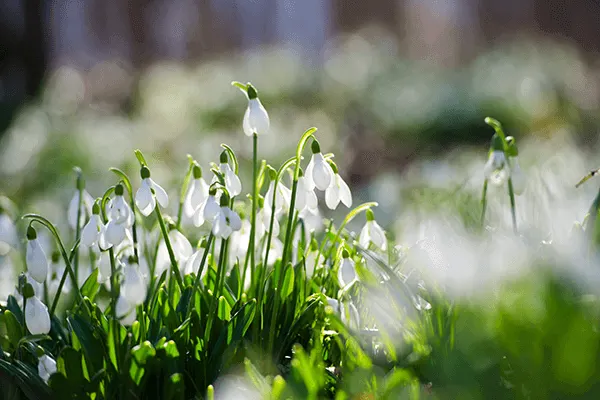
Sure, snowdrops may look fragile and dainty, but that’s far from the case. These pretty white flowers are tough little things and are one of the only flowers that thrive in winter.
If you’ve ever been for a walk through the woodlands or a meadow as the snow starts to melt away, then you’ve probably spotted a few snowdrops popping up and saying hello.
Known as one of the first flowers of spring, snowdrops are always a flower we love to see. And, in this guide, we’ll be exploring its interesting history and meaning, so stay tuned!
A history of snowdrops
Snowdrops are old. Really, really old! They stretch back for centuries, with a Greek botanist and philosopher writing about them as early as the 4th century. But, back then, they were called ‘white violets’.
Because the snowdrop flower has been in the UK for centuries, many believe it’s native to Britain. But they were actually discovered in Europe and the Middle East and were brought over to us by the Romans.
In 1753, Carl Linnaeus, a Swedish botanist, reclassified the snowdrop and declared that it wasn’t a violet at all, but instead part of the Amaryllidaceae family. He officially named it the Galanthus nivalis, which means ‘milk flower of the snow’, but many across Europe were already calling it the snowdrop by that point.
In the 19th century, snowdrops experienced a big boost in popularity, mainly thanks to the Victorians becoming interested in botany and floriography. And they have remained popular ever since. Although for a little while in the 19th and 20th centuries, they were associated with a dark superstition, as people would usually plant snowdrops around cemeteries. So this made people believe that if you found a snowdrop in your home, it would bring impending doom.
Luckily this superstition passed, and now we can all enjoy having little white snowdrops at home without worrying about them causing bad luck.
What do snowdrops mean?
Snowdrops hold a deep and enduring meaning, symbolising new beginnings, hope, rebirth, and the capacity to triumph over challenges. As one of the first flowers to herald the arrival of spring, they're not just a sign of the changing seasons but also a beacon of positivity.
Their white hue further adds layers of symbolism, representing purity, innocence, spirituality, and sympathy, making them an ideal gift for someone in need of encouragement or going through a significant life change.
This rich symbolism of snowdrops extends into the world of literature and art, where they are revered as symbols of hope and renewal.
A notable example is Alfred Lord Tennyson's "The Snowdrop," where the flower is eloquently portrayed as a brave vanguard of spring, resilient in the face of winter's bleakness. The way snowdrops are celebrated in both nature and the arts beautifully intertwines, emphasising their role as a symbol of enduring hope and the gentle yet persistent force of life.
The Snowdrop, by Alfred Lord Tennyson
Many, many welcomes,
February fair-maid!
Ever as of old time,
Solitary firstling,
Coming in the cold time,
Prophet of the gay time,
Prophet of the May time,
Prophet of the roses,
Many, many welcomes,
February fair-maid!
Artists, too, have been captivated by the snowdrop's resilience, often using it to represent new beginnings and the purity of nature. Through these artistic expressions, snowdrops transcend their botanical identity, embodying inspiration and the enduring spirit of life.
Where to see snowdrops in the UK
In the UK, you can see snowdrops in various places during the winter season. These pretty white flowers start blooming from late January to February, marking the start of spring.
You can find them in places like parks, gardens, and forests. Some famous spots to see snowdrops are Stowe Gardens in Buckinghamshire, Welford Park in Berkshire, and Anglesey Abbey in Cambridgeshire. You can also find them growing naturally in the woods, like in the Scottish Highlands or the Lake District.
Snowdrops are a pretty sight in gardens or the wild, telling us that spring is coming.
What do snowdrops mean?
Snowdrops have a very deep meaning behind them. As one of the first flowers of spring, they often symbolise new beginnings, hope, rebirth and the ability to overcome challenges. This makes it a very positive flower to give someone who might be going through a chance and need some extra support and encouragement.
As snowdrops are only available in white, they have meanings of purity, innocence, spirituality and sympathy too.
When should you give someone snowdrops?
Snowdrops make the perfect addition to any bouquets for celebration! Since they have a meaning of hope and innocence, they’re great to give as new baby flowers. And, their fresh, sweet fragrance is bound to uplift sleep deprived parents.
As January’s birth month flower, they can be given as birthday flowers too, as an extra thoughtful gift.
Since snowdrops are also associated with sympathy, they’re appropriate to send as sympathy flowers to express your condolences and let loved ones know you’re thinking of them during a difficult time.
Facts about snowdrops!
Are you ready for your mind to be blown? Here are some fun and quirky facts that we bet you didn’t know about snowdrops!
Snowdrops are endangered, so collecting them in the wild is illegal in many countries, including the UK, and you need a special license to transport them over borders.
There are more than 2,500 varieties of snowdrops.
Rare snowdrop bulbs can cost £100s!
They contain a substance used to treat symptoms of Alzheimer's.
They usually flower between January and April.
Want to learn more about spring flowers? Take a look at our Daffodil meaning guide, Tulip meaning guide and our Primrose meaning guide too!