
Carnation flower meaning and colour guide
With a fascinating history that spans across 2,000 years, carnations are full of meaning and symbolism! These gorgeously fluffy blooms have stood the test the time and are still a favourite flower for many occasions like weddings and birthdays.
Their light, sweet scent and huge range of colours make the carnation flower a delight for all the senses. Keep reading to find out more about the ever-popular carnation and its different colour meanings.
Where do carnations originate from?
Did you know that carnations are actually one of the oldest cultivated flowers in the world? How amazing is that?! They were discovered all the way back in Ancient Greek and Roman times by Theophrastus, one of the earliest known botanists.
Mostly grown in Europe and Asia, carnations were loved by so many and used in art, decor, wreaths and perfumes. And they had some pretty major health benefits too! For those who felt stressed, brewing a delightful carnation tea would help to elevate those feelings and give them a nice big boost of energy. Plus, they were used to treat things like stomach aches, fevers, reduce wrinkles and other skin conditions. No wonder they’re known as the ‘flower of the gods’!
How did carnations get their name?
So, where did carnations get their name? Well, there are many theories and legends on this. Some say it originated from the word ‘coronation’ as the flower was used in Greek ceremonial crowns. But, others think it came from the Latin word ‘carnis’ which means flesh because the early carnations were pretty much only pink.
The truth is, no one really knows the origin of the carnation name, not even flower experts like us! But, what we do know, is that the scientific name, ‘dianthus caryophyllus’, came from the mighty Zeus. In the Greek language, Zeus is translated as ‘dios’ and the word flower is ‘anthos’ and so ‘dianthus’ was born! Yet another reason why carnations are classed as the ‘flower of the gods’.
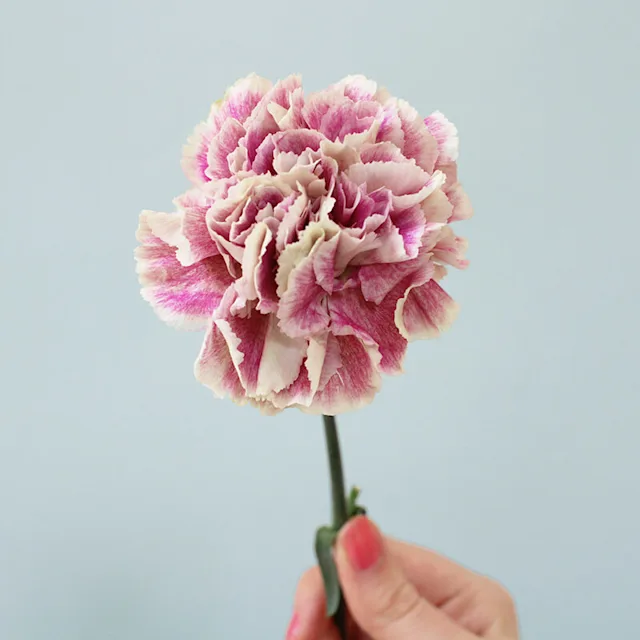
What do carnations symbolise?
As carnations have been around for quite some time, they’ve been associated with many different symbolic meanings in different cultures. Generally though, carnations symbolise:
Devotion
Carnations are the perfect choice for those about to tie the knot as they represent devotion. In fact, many famous Renaissance painters used the carnation flower in their engagement scenes in the 15th and 16th century. So, using them in the bridal bouquet, button holes or table decorations will make a wonderful statement!
Love
Following on from devotion, carnations also symbolise love. Whether it’s familial love, romantic love or the love of a friend, carnations will make for a lovely gift for many occasions like Mother’s Day, birthday’s or an anniversary.
Distinction
Because of their unique and charming shape, carnations are known for symbolising distinction. They really know how to stand out from the crowd! They’d be perfect to give to that lovable, quirky person in your life.
Fascination
Many people also associate carnations with fascination as they are fascinating and captivating to look at. And they have been included in poems, paintings and songs for centuries. If you’ve been given a bunch of beautiful carnations we bet that person thinks you’re a truly fascinating person.
What are the different carnation colour meanings?
When they were originally discovered, carnations were really only found in shades of pink. But, they have since evolved to include a wide spectrum of colours, each with their own special meaning.
Pink carnations mean gratitude
Pink carnations are the most commonly found colour and symbolise gratitude. Most people usually associate pink carnations with Mother's Day. In fact, in America carnations are the official Mother's Day flower. But, they're also a great way to say thank you and to show your appreciation to a teacher, nurse, co-worker or a friend.
White carnations mean purity and good luck
White carnations are truly beautiful flowers that represent purity and good luck. So, if you know someone who needs a little extra luck in their life, whether they're newly engaged, just graduating or embarking on a new adventure, white carnations are the way to go!
Red carnations mean love and affection
Did you manage to guess this one? It should come as no surprise that red carnations symbolise love and affection! Imagine receiving a bouquet of gorgeously vibrant red carnations from your partner... swoon much?! While they are typically used to express romantic love, they can also be given to anyone who you feel particularly close to.
Yellow carnations mean disappointment and rejection
While they are incredibly pretty, yellow carnations don't have the happiest meaning. Symbolising disappointment and rejection, yellow carnations are best to send to someone you need to say sorry to. They're also acceptable to send in times of sympathy.
Purple carnations mean capriciousness
Purple carnations are an interesting one as they symbolise capriciousness. If you have an impulsive or unpredictable friend or family member, then purple carnations are perfect to send before their next big adventure! Purple carnations are also the best flowers to send if you're unsure on how your gift will be received.
Orange carnations mean desire
Orange carnations represent desire, enthusiasm, and fascination. They can be given to express admiration or to show your interest in someone.
Blue carnations mean mystery
Blue carnations are not naturally occurring but are often created through dyeing. They symbolise mystery and the un
The different types of carnations
Carnations come in different types. The Standard Carnations, small ones called Miniature Carnations, and some with multiple blooms on one stem called Spray Carnations.
Pinks, or Garden Carnations, have a spicy smell and are good for gardens. Some special types have fringed petals or unusual colours, like blue or lavender. These different types of carnations offer various looks and scents, making them great for different occasions and preferences in flowers.
Flowers that look like carnations
Several flowers look a lot like carnations, with similar petals. Let's take a closer look at five of these flowers that share some of the charm of carnations but also have their own special features:
Dianthus (Sweet William): Dianthus flowers, particularly Sweet William, are closely related to carnations and share a similar appearance, with fringed or serrated petals and a delightful fragrance.
China Aster (Callistephus): China asters have double-layered, daisy-like blooms that can resemble carnations, especially when they come in similar colours like pink and white.
Stock (Matthiola Incana): Stock flowers feature tightly packed clusters of petals, creating a dense, carnation-like appearance. They are often used in floral arrangements and share a pleasant fragrance.
Godetia (Clarkia): Godetia flowers have double or semi-double petals and come in various colours, making them resemble carnations, especially in their fully bloomed state.
Scabiosa (Pincushion Flower): While Scabiosa flowers have a different petal arrangement, their rounded, pom-pom-like appearance can be reminiscent of carnations, especially in certain varieties and colours.
When do carnations bloom?
Carnations typically bloom in late spring to early summer, depending on the specific variety and local climate conditions. In temperate regions, this usually means they will bloom from May to July. But some carnation varieties are bred to bloom at different times of the year and can be found in flower shops year-round.
Do carnations come back every year?
Carnations usually don't come back every year. They are often grown as plants that last for just one or two years. In some places where it's not too cold in the winter, some carnations might come back for a bit longer, but it's not very common. Most people plant new carnations each year or make new ones from cuttings to keep having flowers.
How long do carnations last when cut?
If you put carnations in a vase with water, they can look nice for about one to two weeks or even longer if you take care of them. To make them last longer, cut their stems at an angle, change the water often, and keep them away from hot sun and drafts. Carnations are good at staying fresh in a vase for a while, which is why people like to use them for bouquets and decorations.
Fun facts about carnations!
With their long history spanning across multiple different cultures, there's a lot to learn about carnations! Here are some of our personal favourite fun facts:
- Carnations are the official January birth flower.
- In China, carnations are the most popular flowers to use for weddings.
- They're also the official 1st wedding anniversary flower (note that one down if you've tied the knot recently!


